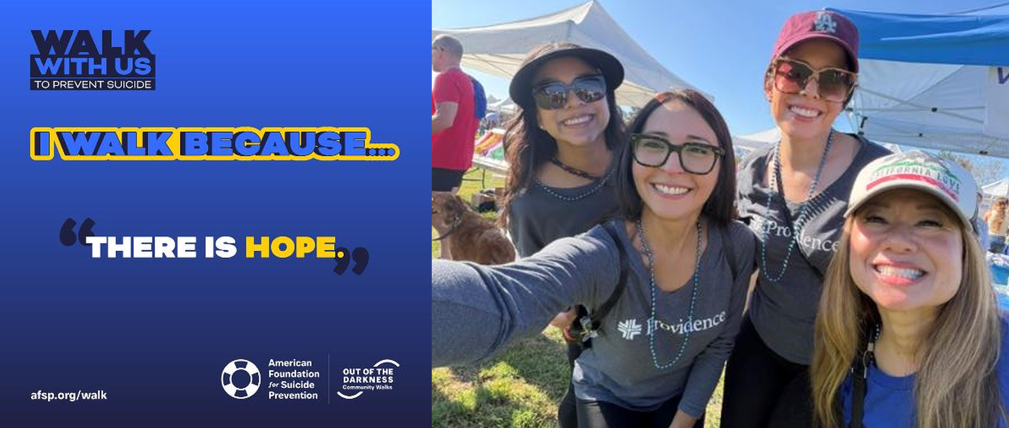
Providence caregivers are shown at the September 26, 2026, Out of the Darkness Walk in Irvine, California. Pictured above (from left): Adaligza Medina, behavioral health therapist, Providence St. Joseph Medical Group, Tustin/Orange; Diana Alcantar, director of behavioral health and primary care integration, Orange County & High Desert; Michelle Flores, senior manager, behavioral health; and Linda Huang, regional manager, ambulatory care management.
For the past five years, Diana Alcantar, M.S., director of behavioral health, Orange County & High Desert, Providence Medical Foundation, has co-led the Out of the Darkness Walk (OOTDW) in Irvine, California. Organized by the American Foundation for Suicide Prevention, the community event raises awareness, honors loved ones and helps fund suicide prevention efforts. She recently joined several Providence caregivers to participate in the OOTDW on September 26, 2026.
In this Q&A, Diana, a licensed marriage and family therapist, reflects on the personal and professional experiences that have shaped her commitment to mental health and well-being, the moments that keep her returning to the walk each year, and how each of us can offer meaningful support to people affected by suicide loss.
How long have you been involved in the Out of the Darkness Walk in Orange County?
I have been co-leading the Out of The Darkness Walk in Orange County with other Providence leaders for five years. This has truly become a passion project for us because it carries personal meaning for each of us. Over the years, physicians, caregivers, and families have joined in this effort. We are grateful for Providence’s continued support in helping raise awareness about suicide prevention.
As a therapist and behavioral health leader, what has shaped your commitment to mental health and well-being?
At an early age, I witnessed firsthand how mental illness can affect the entire family. It can leave loved ones feeling alone, misunderstood, and deeply impacted by loss. The person experiencing mental illness may become emotionally withdrawn, making it difficult for the family to recognize the person they once knew. The sense of loss can be profound, even while that person is still present. My commitment to mental health only deepened further as I watched my own parents navigate my brother’s struggle with addiction. Through both my personal experiences and professional journey, I came to understand the importance of living with intention and purpose, while centering advocacy, awareness, compassion, and overall well-being. Today, as a therapist and behavioral health leader, these experiences continue to shape and fuel my commitment.
What keeps you coming back to the walk each year?
The stories, the community, the people who participate and care about the work are what bring me back year after year. One of the most special parts has been getting to know my colleagues on a more personal level as we come together around a cause that means so much to us. Mental health is often overlooked, and these walks are a reminder that mental health is real, and it does not discriminate. It can impact people from different walks, backgrounds, and cultures. Returning to these walks is a great reminder for us to live with intention and purpose.
Is there a moment from a past walk that has stayed with you?
Although every walk feels significant and meaningful, the most difficult and impactful stories are often about children who have lost their lives to suicide. Last year, I saw a picture of a child who died by suicide at just eight years old, and it broke my heart. It is a powerful reminder that mental illness can affect anyone, at any age. Too many people suffer in silence, unaware that help and support are available to them. This is why partnering with the American Foundation for Suicide Prevention is important. It allows us to raise awareness and use the platforms available to us to remind others that they are not alone. There are people who care and are willing to walk alongside them, reminding them that asking for help is not shameful; it is a courageous act. Together, I believe we can help save lives, one step at a time.
For someone who wants to be there for a suicide loss survivor, what is most helpful to say or do?
Because grief is complex and looks different for everyone, I always recommend approaching the conversation with curiosity. Maybe it’s asking, “How can I be here for you during this time?” Some people might need a safe space to talk through their grief, while others may find comfort in having someone accompany them to places that remind them of their loved one. Asking what type of support would be most meaningful can be one of the most helpful things you can do for someone.
How does participating in an Out of the Darkness Walk help build hope and connection?
Helen Keller once said, “Alone we can do so little; together we can do so much.”
Those words deeply resonate with me. I believe that when people unite around a shared commitment to mental health, we can amplify a message of hope and unity. It can help break down barriers and reinforce the importance of mental well-being. Most importantly, when we work together as one, we can help others feel seen, loved, and valued.
My hope and prayer are that these walks and advocacy groups are a reminder to those suffering in silence that you are not alone, help is available, and your life matters. 💚
Learn more about Out of the Darkness Walks taking place in cities nationwide: Out of the Darkness Walks.